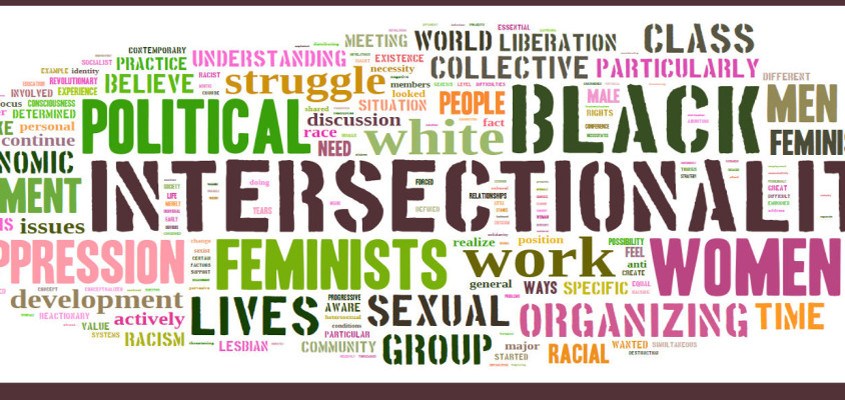
Let me be honest and confess I never knew what intersectionality was – had never heard of it, never ever heard of Kimberlé Crenshaw or her wonderful work. Having overheard the word in a conversation at work, I asked one of my professors about it, and he told me that “Intersectionality recognizes that identity markers (e.g. “female” and “black”) do not exist independently of each other, and that each informs the others, often creating a complex convergence of oppression… It’s a word we often hear but rarely understand, but now it seems to be a word on everyone’s lips.”
This textbook definition kind of made sense, but not really. It struck me as one of those things that is easier to read but hard to wrap your head around. And then, not too long ago, I had a moment that made me ponder about identity and its ramifications far more deeply than I ever had.
It was a Friday afternoon about a year ago in March. I was on Spring Break from my Business School classes and desperately trying to catch up on final assignments. I was just leaving the office after work and as I stepped out of the building, I got a frantic call from my brother in Mumbai. “Mom’s not doing well. She’s in the ICU, and it does not look good.” Between my getting on the train at South Station and getting out of the train at Alewife, and the pockets of dead cell reception in between, I had received the few dreaded instant messages that relayed the bad news that Mom had passed away. I reached home rather numb and began scrambling for tickets. Messages were going back and forth between my two brothers and I about whether I could make it to the funeral or not. As I sat in front of the PC, desperately looking for tickets to the next flight possible, it suddenly hit me that I could not just pack up and leave – I now needed a visa to go to Mumbai! When I had become a citizen a year ago, I had to give up my Indian passport. In one fell swoop, I experienced privilege and deprivation in the same instant.
I pondered on this a lot on my long flight to and from Mumbai. I began to understand that while identity can be contextual it is quite critical in defining one’s life experience. And when identities overlap, the experience becomes more complex and nuanced. Intersectionality was, as my brother put it, a double or triple whammy, like someone being an immigrant, and gay and Muslim.
I then thought about what was happening around the world, the various movements dealing with overlapping oppression at multiple levels and dimensions. I began to get the feeling that understanding intersectionality is essential to combat the interwoven prejudices marginalized people face in their daily lives. Taking this a step further, I felt an intersectional look at how immigrants practiced citizenship could give us key insights into the ways in which groups marginalized by race, gender, ethnicity, class, and other social forces build and sustain communities of resistance and transformation towards social justice.
My community, the Indian-American community, is one of the fastest-growing immigrant communities in America. Today, we have close to 4 million individuals who were either born in India or report Indian ancestry or race. One of the first things people ask me when we meet for the first time, is where I am from. When I tell them where I live, they will ask me, “No, no, tell me where are you really from?” This is where the sense of alienation, of not having an identity or franchise stings. So the question becomes: Do I feel Indian enough or American enough? Or neither?
For most immigrants, including Indian-Americans, gender, class and ethnic relations get reshaped as women and men adapt to life in a foreign country. Being a woman, especially an Indian wife staying at home in America has its own poignantly interlocked oppressions. She is discriminated at home because Indians are traditionally highly patriarchal. She is also socially discriminated since her legal status is completely tied to her husband’s – it is almost as if she becomes illegal if she were to walk out of her unhappy home. And if she is plucky enough and lucky enough to find a job, she faces gender and racial inequality at work.
Who speaks for these silent sufferers who have no suffrage? In the media and our privileged circles, we only hear about the Sundar Pichais, the Satya Nadellas, the Shantanu Narayens and other successful faces of Indian immigration. Who hears about the Punjabi trucker in California who is forced to accept reduced wages or zero health benefits or lose his job?
Which brings us to the much less well-known statistic that the unauthorized Indian immigrant population has experienced one of the greatest growth rates amongst all unauthorized immigrants, increasing by 914 percent since 1990. The oppression that this segment suffers is made even worse because it is never talked about. When I was on an H1-b visa, trying to get my green card processed, I went for years without a raise or bonus since I was effectively a bonded laborer, but all that pales in comparison to some of the horror stories about undocumented immigrants.
Perhaps the most famous case would be one that a lot of us may have read about in the papers. It was about the live-in maid who worked for the Indian Deputy Consul General in New York a few years ago. She had faked her Indian nanny’s visa claiming she would pay her wages of $4500 a month, when in reality she paid her about $3 an hour for 18-19 hours of work every day. When she was arrested, she pulled strings with the Indian Foreign Ministry and got a posting to the United Nations that granted her diplomatic immunity.
A year before that, another Indian diplomat in New York, had brought over an underage Indian girl to work without pay and subjected her to barbaric treatment – seizing her passport, confining her to the apartment and forcing her to do menial labor.
Nobody really cares about these cases or the hundred others that go unreported, because they don’t concern white women, the subjects are not American, and they are probably lower caste women. In New Jersey, where attendants pump gas into your vehicle by law, many gas stations employ undocumented laborers to pump gas. They often work in abject conditions in snow and rain for bare minimum pay, often living in squalor and poverty. After 9/11, one such pump jockey was shot to death in Arizona in a racially motivated attack, since Sardarjis, or Sikhs also grow their beards long and wear turbans like devout Muslims do.
But this concept is not new: way back in 1903, W.E.B. DuBois wrote in his treatise The Souls of Black Folk that oppression does indeed operate in complicated, “interlocking” ways. Reflecting on this harsh truth and recognizing that all unique experiences of identity are valid, is how intersectionality helps change our perceptions. Using identity as one of many lenses to see the world more completely is what ends up making intersectionality the important framework that it is.
A way of expanding usefully on this idea would be to understand how discrimination plays out in different cultures. Maybe I can start by answering the question a lot of folks ask me when they meet me for the first time and ask me what religion I am. I answer that I am Hindu (as opposed to Hindi, heh heh). The most common follow up question to this is about the caste system. The caste system, which is one of the oldest forms of surviving social stratification, plays a huge role in determining privilege or oppression back home. Despite affirmative action and the Constitutional banning of discrimination, the ground reality is quite different. Caste remains a significant factor in deciding everything from family ties and cultural traditions to educational and economic opportunities, especially in small towns and villages, where more than 70% of Indians live. Nearly a third of Dalits make less than $2 a day, and many don’t have access to education or running water. Most menial jobs are carried out by Dalits; few office jobs are. Hate crimes against Dalits have proliferated in recent years.
There is also a clear divide between the rural versus urban educated elite, with a lot of social and political thought leadership getting coopted by the latter for the “greater good.”
A lot of this variance is reflected in the Indian American community, with what you see as successful immigrants being the upper caste or urban-educated elite and the undocumented “Dreamers” being of the lower caste or working-class proletariat.
Another discrimination, which is very subtle, and is also banned under the Constitution of India is that of color of skin. If you look at most popular Bollywood actresses, they appear to be very fair. This is because of a bias towards fairer skin tone. Dark-skinned heroes and heroines do not “sell.” The mental models and confirmation bias are so deep-rooted that Unilever has an extremely successful product in India called “Fair and Lovely,” which is a skin-lightening cosmetic that promises fairness of skin and loveliness of personality to users. This brand has more than a 50% market share of a $450 million market. And I could go on and on with other examples.
However, what could be really valuable is to view all these life experiences framed through intersectionality. Intersectionality becomes the organizing principle that ensures that one marginality is not substituted for another. And lived experiences are not treated as generic and undifferentiated. By mapping the fractured nature of the everyday, a lived experience allows us to be open to competing interpretations. This framework is what helps truly intersectional thinkers to be highly attentive to the points of view of different people subject to different kinds of oppression. It is what helps them to want them all to have their say, to compare their views to their own. To borrow from standpoint theory, the perspectives of marginalized and/or oppressed individuals can help to create more objective accounts of the world. Through the outsider-within phenomenon, these individuals are placed in a unique position to point to patterns of behavior that those immersed in the dominant group culture are unable to recognize. Standpoint theory gives voice to the marginalized groups by allowing them to challenge the status quo as the outsider within. And, in the process, to learn that the vast majority of African Americans, Asian Americans, Hispanics, socioeconomically disadvantaged Americans, immigrants, Muslims, Hindus, non-Westerners, and perhaps even non-cognitive elites, among others, hold different, contrary views about how power and language work. A Level Three leader armed with such deep insights would then be able to harness high levels of productivity and motivation from all associates, regardless of their ability and origin stories and build an inclusive workplace – a truly inclusive one, in which the rainbow flag of a Pride resource, for instance, would be able to cut across boundaries and co-opt Holi, the Hindu festival of colors as their own. Or a Women’s Group would become the biggest ally of a Disabled Veterans’ Group. As John Jermier says, “if our desire is to heal the world, we will learn more about how the root mechanisms of the world work and about how things can be changed by adopting the standpoints of those people and other parts of nature that most deeply suffer its wounds.” Let’s all work towards getting there as gracefully and quickly as we can. With humility, with openness, with empathy and, most importantly, with love.
 Reflections