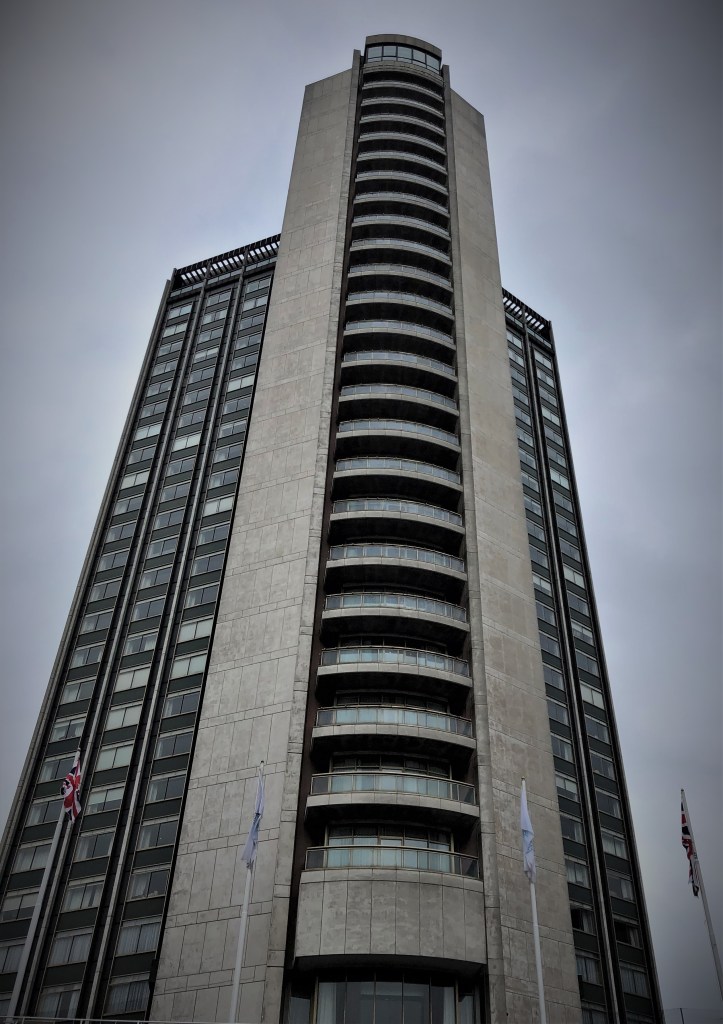
High-Rise

He somehow climbed on to the roof (staggering to make it up the stairs) to look at the bright lights of the city: high-rises that were lit up like Christmas trees (with airplane beacons twinkling on top), the helipad lights on top of the Children’s hospital, advertising hoardings, neon lights, the occasional police flashers, the odd flare-up or two…

He thought, how can there be so much light out there and so much darkness inside me?

He somehow managed to negotiate his way to the edge of the roof, marking a zigzag pattern of blood as he did this, and looked down the 25 floors to the ground. The people walking down there on the ground seemed like ants (to his grasshopper?), busily going about their business while he stood and contemplated life or death. Looking directly down made him dizzy… spinning round and around, like a paper in the gust from American Beauty. So he tried not to do that, since, if he fell, he wanted it to be an act of conscious volition and not a moment of physical weakness. Instead, he tried to look ahead, only catching snatches of the sights below him from the corner of his eyes. And that seemed to make things appear either doubled up or almost as if they were surrounded by a halo.

A boy shouted to a girl. The girl turned around and saw him. She ran up to him and they embraced and kissed. Haloes around them both. So much love in this world, but none for me, he thought. A mother walked her toddler through the park adjacent to the high-rise that he lived in. Faint snatches of conversation drifted up to him in the wind. A raucous group of teenagers now made their way across the park. One of them looked like Maria, he thought. Maria, Maria, she reminds me of a West Side story… How could she not see the love he had for her? Couldn’t she sense the purity of emotion, the sense of beauty and innocence that he radiated towards her? All she said to him was “Good morning” and “Have a nice night” at work, but he always felt like she said it every time as if she meant it especially for him.

Now he thought, how would it feel when I jump? Falling falling going down down down black tar horse brown sugar up my veins cocaine down my nostril dripping down my windpipe (“the drip is the best,” Julianne Moore said in Boogie Nights) riding the train wind rushing through my hair fear pain life sucks and then you die excuse me for dying no remorse no regrets another day another death help-I-am-out-of-my-body weightlessness thump thump squish end of thoughts.

Thoughts knifing into his heart, thoughts rushing through like adrenaline, thoughts that succeeded a panic attack. Sitting in a corner, cowering, really. Air is rare, breathing is hard. Heart is going at 240. Nothing is in focus. Except the framed degree on the mantelpiece. Master of Arts. New York University. Meaningless, really. Like the little teddy bear Maria gave him as a Christmas gift last year that came to life when he was asleep, taking an inventory of his life space and nodding in disapproval.

The teddy’s name was José (Hasbro’s gesture of recognition to the rapidly rising Hispanic population in the country). He was not particularly friendly, ever; he defined a “bearish temper”. When Maria gave it to him at the Christmas party at the office, he sensed the underlying anger in José. But then he wasn’t one to look a gift bear in the prognathous muzzle. After an extra drink (to celebrate his being finally noticed by Maria), he walked home in the chilly, snow-driven night, clutching José close to his chest under his unfashionable Burberry. Laughing too loud to himself, stumbling when the street lights refused to aid his humble attempts to walk straight, he finally reached home and even before he took off his coat, he had installed José on the mantelpiece.

A few nights later, José decided it was time to act. He didn’t like being a teddy bear to this guy (“He doesn’t even cuddle, dear.”). So he crept down from the mantel and slowly dragged his plastic-bead-filled body to the sleeping man. He took his time climbing up the bedposts, but once he could within the man’s earshot, he was happy. His karma was real.

“Kill. Die. Kill or die. Kill and die. Die, muthafucka. Kill. Die. Death becomes you…” Almost like a litany, the bear kept repeating this into the man’s ear every night it felt strong enough to make the journey from the mantel to the bed. José’s fur began looking more ragged; he developed a bad cough—could’ve been the beginnings of tuberculosis or from smoking too much pot. But José single-mindedly went about his business.

When Maria died, people in the office “tsk-tsk”ed a lot but no one ever actually found out how she died. The police hadn’t released much information, since they were still investigating and it was being put down as “death by misadventure”. Actually, it was more like death as an adventure. He first asked her out—that’s how she began to die. As the evening progressed, she began dying by degrees. She couldn’t fathom why she had agreed to go out with this guy. As the two glasses of wine began to take effect and the meal wound down, she agreed to his offer to take her home.

He couldn’t exactly remember how José had programmed the evening: Car door skirt riding high flash of Victoria’s Secret intoxicated/intoxicating laugh keep the change, motherfucker, biff bang racial attack dragged and snagged over cobblestones fumbling through keyholes mumbling sweet nothings Maria staggers in here’s the bedroom, dear can I fix you something? Next she’s naked and he’s impotent and she’s laughing jeering cheering egging on pick up something blunt and heavy BANG BANG on her head she’s passing out so long BEE-YATCH.

Next morning, when he woke up, he was in Maria’s apartment and just couldn’t figure out why she wouldn’t answer him. He got up, dusted off his pants, let himself out of her apartment and got home. “Hi, José!” he shouted out to his teddy bear. José winked back at him.

At the office, everybody was talking about Maria’s death. Nobody had too many details, but the mailroom guy had actually “heard the cops say that she died of a broken neck, dawg. Dammit at all to hell!! Heard some dude pushed her into the trash chute last night. Jeez!!!” That’s that, he thought. Let’s go home. There’s nothing to keep me here—neither her bucolic face nor her beatific smile.

He stopped at the liquor store near his house before going home and proceeded to get roaring drunk, listening to the Yardbirds. Then he somehow got the idea that he should cut up some raw mangoes (with a little salt and cayenne mixture to dip them in) to go with his vodka, but managed to cut his hand instead. The bleeding refused to stop despite his going through a whole roll of Bounty to staunch it.

He first began to think of going up to the roof only after the Seinfeld rerun that had Kramer stuck on somebody’s roof. (José took the opportunity to shout out his approval, “Yoo-hoo!!”). He turned to José and stood up. He waved off a salute that ended up looking like a gesture from a man with a headache and decided to go up. He picked up his keys ha ha how funny I am drunk but I remembered to take my keys before I latched the door shut. Pushed the elevator button and spent the time waiting for it ogling at the pretty girl from down the hall who was waiting for a ride going down.

As he opened the roof access door, he was hit by a big gust of wind. I want to get away, I want to get away, I want to fly away. Being summer, it was quite warm in a Freudian sense. The moment he stepped on the roof area, he knew something was up. (And it wasn’t the heavy breathing and muffled groaning of the co-ed couple making out in a darkened corner of the area.) And once he launched himself into the swan dive over the short wall enclosing the roof area, he discovered that he felt truly free and in love. He also discovered another fact: It takes a while before you hit the ground life passing before your eyes too much pain too little lovin’ life’s a bitch kerr-thud splat death is meaningless. The only sound up there on the roof after that was the couple making love. And the gruff voice of a teddy bear laughing.

Catamaran

The big, bright red motorboat moored far away in the distance lapped lazily back and forth, dancing with the gradual ebb and flow of the waves that followed their invisible lunar directives. The Arabian Sea looked very calm this morning. The old man had told me earlier that the southwest monsoon winds weren’t due for two more weeks. He was sitting right beside the few logs that made up his kattumaram, which he fashioned by lashing together thick logs of light wood. Like a good fisherman, he understood how important it was to tie the logs together securely. As a young boy, he practiced until his fingers could tie and untie the knots in his sleep. Very early, he also learned why he must untie the logs after a fishing expedition and dry them in the sun. This prevents moss from forming on the logs. Slippery logs are dangerous in the sea, especially when a fisherman is hauling in a net full of fish. Or when the sea is rough. Right now, he was squatting next to his drying logs, busy patching in a couple of tears in his tired-looking net.

He had told me that he was a prawn-catcher by tradition and birthright: his father, his grandfather, his great-grandfather and others before them had all fished the depths of the Arabian Sea for chemmeen.

He knew no other aquatic life form better than the Heterocarpus gibbosus or the deep-sea prawn—from long years of sailing in huge catamarans with hardy fishing crews, he knew the best spots to find them. He could predict their seasonal movements as the monsoon blew the choppy Sea inward to the peninsula.

“But I’m old now,” he said as he threaded a long needle with twine. “I cannot battle the tempests alone anymore. My sons, they never wanted to do this work—it is beneath them, they say. So I do what I can do on my own, but even the bravest fisherman of the Malabar coast won’t dare go after chemmeen without a crew in a strong catamaran.”

“What do your sons do?”

“Oh, one of them is a local trade union leader, while the younger one—the smarter one, if you ask me—has gone to work in the Persian Gulf. He works at the Abu Dhabi airport. He makes good money, I guess—keeps writing back that next time around, he’ll come and buy me a fancy catamaran with a motor and everything. Ha ha ha, tell me, why would a simple old fisherman like me need a kattumaram with an engine?”

His skin was the shiny black of lignite from the Neyveli mines in Tamil Nadu. The wrinkles in his face were deep crevasses that formed natural pathways for the sweat from his forehead to trickle through, creating natural deltas on his face. His back was slightly bent with age, but his body still retained the strength and nimbleness of his youth. With the net spread out over his varicose-veined legs, his wizened yet deft hands quickly went about their work.

We set out as the sun approached its zenith and a mild zephyr blew into the swaying emerald green array of coconut palms, transporting the faint scent of our evaporated sweat along with the sharp tangy odor of the sea back to the shore. The sun was now high and bright in the nearly cloudless azure sky, the catamaran bobbing gently up and down. Not used to this weather, I was tiring very quickly out in the hot sun. The old man seemed in his element, and started singing an old fishing song in his native Malayalam, as he slowly paddled and set off:

“The wind blows from the south

Bringing salty memories of my brothers

Who thought they could brave the sea

And stare into the eye of a storm.

Meanwhile,

My heartthrob waits at the shore’s edge

Scanning the horizon, anxious for a sign

That her loved one has made it back safe

From the bosom of the sea into hers.”

As the catamaran skimmed along over the tepid waters under the old man’s gentle urging, I lay down inside the canoe with a wet coarse linen towel placed over my eyes as a sunshield. I dozed off before we even lost sight of land. I woke up with a start when the old man started chanting some incantations to propitiate his sea gods who would ensure him a good catch before he cast his nets. I laughed and mockingly asked him, “Was that a prayer to Poseidon or to Brahma?” He said, “I’m just a foolish, illiterate fisherman, what do I know of all that? That is for college-educated smartasses like you to figure out. I pray, like I do every time I sail, to my Amma, the sea, to take care of me. Rest I leave in Krishna’s able hands.”

He stood up to cast his nets without seeming to affect the balance of the boat at all, and then sat down and brought out his little bundle of beedis. He offered me one and in response, I just brought out my pack of Gold Flake Kings and lit up. The old man didn’t light up—instead I watched him as he carefully untied the beedi and took out the tobacco. He brought out a small pouch from the multipurpose money belt he always wore around his lungi and opened it up with deliberate, smooth movements. Deftly picking out a few buds of marijuana (which to me looked heavily encrusted with tiny white crystals), he mixed it up with a little tobacco and went about the delicate business of tying the beedi back. Then he lay back on the catamaran and lit up his joint. His aged cheeks resembled deep, uneven pits as he inhaled deep. After a couple of drags, he sighed and sank further down into the boat. A few minutes later, as he spat into his palm and stubbed his beedi out in his saliva before throwing it into the sea, he began to reminisce.

“You know, my boy, things used to be so much better before. The waters were so bountiful. Everyday used to be a great day for fishing. Now we are more likely to find shoes, plastic bags and other garbage in our nets.” He stretched his limbs and laced up his hands behind his head. He continued, “Surely, it’s a sign that Kaliyuga is upon us. Now only the giant deep sea trawlers with their big motors and scientific machines who prospect for days at a time come back with any kind of catch worth the while.”

“Then why do you keep doing it?”

“I and my ancestors know no other life. But the cycle has already been broken—neither of my sons will do this. I’m the last of my line, so to speak.”

“Well, I suppose it’s still a living,” I said, very blasé.

The old man didn’t respond. A minute passed, while he looked out towards Kanya Kumari, way out there in the middle of the horizon, where if you could see far enough, Vivekananda’s Rock marked the spot out like an ‘X’. Then he suddenly fixed a calculating stare on me, hardly looking like someone who was just getting high. Rather too sharply, he said, “My Amma weeps, for she is sad. Her honest followers have all disappeared gradually, leaving her to the mercy of faithless plunderers. Look at what they have done to her. The waters are muddy, where I could once dive 50 feet down and you could follow my progress from up here. The fish are drying up because they catch far more than what they need. And now Amma retaliates by sending terrible hurricanes and cyclone winds up the Arabian Sea and making the chemmeen harder to find with each passing season. But there is nothing I can do as a dutiful son—nothing I can do to protect her honor.” There was anger in his voice.

“But surely, you still catch enough to feed you and your family, right?”

The old man shrugged but didn’t answer; he looked away, into the water where his nets were submerged. Soon he was busy fussing with the nets and trying to manipulate the canoe into a better position. As the sun began changing color and the water began reflecting its shimmering, golden-hued brilliance like tiny little pirate’s doubloons afloat on the water, he suddenly began muttering to himself and quickly started pulling the net up.

It came in easily at first, but as the net grew shorter, I perceived it was either heavy or snagged. So I got up to help. The boat lurched a bit and the old man roundly cursed at me but didn’t let go of his net. We got both our hands on it and started reeling it in. Pretty soon, the part of the net holding the catch was right next to the canoe but I still couldn’t figure out what or how big it was. “Do you always catch so many prawns, old man?” I asked. The fisherman sardonically smiled in answer, because the catch had just made contact with the side of the boat, a thumping sound like a box or something. Surprised, I leaned over to look and overbalanced and fell into the sea. The old man instantly dropped the net and jumped right in after me. Before I realized I was drowning, he had me in a vice-like grip and swam back with me to the boat in smooth, easy strokes. He made me hang on to the sides while he climbed in and then helped me clamber aboard.

After I’d finished sputtering and shivering, I realized that he was now circling the canoe around, since it had drifted some way during my accident. With a pang of guilt that overpowered my shock, I remembered that I’d inadvertently caused his day’s catch to fall back into the sea. He paddled this way and then the other and finally, with some built-in homing instinct, he stopped at a particular spot and stripped down to his loincloth. Seeing the confusion in my eyes, he explained, “I lost my net as well, which means I can’t go to work until I find it. I have to go find my net.”

He jumped in and I could hardly make out his dark, amoeboid outline in the murky waters and the gloaming sun. He came up a couple of times for air, and then went down for a long time. I began to fear the worst, worrying more about the fact that I didn’t even know how to paddle right, let alone navigate back to the shore by the night sky. Just when I was giving myself another guilt trip, this time for causing a poor fisherman’s death by drowning, he came up with a piece of the net. “Hold on to this, tight as you can. I’ll go back and see if I can still find the catch.”

In a while, he came back up. He climbed back into the canoe smooth as silk and began pulling up the load. Again, it made the thump on the side, but this time I didn’t dare peek. The sun was now almost down and the light was fading fast. I could barely make out the shape of the catch—it kind of looked like one of those carboys we used to take to the government ration shop to buy kerosene in.

We quickly reeled the rest of the net in and set off back to the shore. The old man lit up another beedi, as the wind gently took us shoreward.

As he began puffing away, I asked him, “You offered me a beedi earlier. So how come you didn’t offer me a drag when you were smoking pot?”

“I had already touched it with my lips. How could I offer you something already tasted by me?”

We both fell silent. As we pulled the boat into shore, I kept trying to sneak a closer look at the catch. The old man first methodically took the nets aside and folded them before pulling the carboy out. It seemed heavy and he dragged it slowly behind him to his hut. I followed him to the hut but waited outside. After a moment, he came back out to untie his kattumaram and spread them out in anticipation of tomorrow morning’s sunshine. Then he invited me into his humble abode.

“I’m sorry I caused a problem out there,” I said, as we sipped some strong Malabar tea.

“Nothing to it. City slickers don’t have any understanding of balance. Happens all the time. But you are lucky, I must say.”

“Well, I’m relieved you didn’t lose your net or catch.”

He didn’t reply. Instead, he took a long sip of his tea and asked, “You asked me earlier why I didn’t offer you a drag from my joint. So what do you say now? Do you want to smoke?” Without waiting for an answer, he went in and brought out the black plastic carboy. “Today’s catch,” he declared, as he opened its watertight seals. He reached in and removed a couple of big red-haired buds. As he proffered them, his eyes twinkled and his mouth stretched in a wide, toothless grin. “Surprised, huh? To the few who are left out here like me, the sea out there is our Amma. It also symbolizes a way of life that has possibly gone out of fashion. We are but like the sea gulls, the scavenging survivors, seeking to balance our old ways against the new. I still go out in my canoeevery day, much like I used to with my brothers in our catamaran, but these days I fish for another kind of chemmeen. That way of life has become too old-fashioned for the people who don’t care, who only consider Amma as a means to transport their drugs and weapons in their fancy trawlers. I see them almost every time I go out fishing. I track them sometimes. And sooner or later, when I get the chance, I try and get one up on them. Like today, when I sank my net at a regular drop-off location of the trawler I’ve been keeping an eye on for a while.”

There was a knock on the door outside. Still smiling, the fisherman went to let the caller in. There was a short conversation between the two and he came back in right away, took some quantity of the stuff out from the carboy, tore a little piece of old newspaper to wrap it in and went back out. Money and bud exchanged hands, yet they stood around chatting—two poor fishermen neighbors chewing the fat on a desultory moonlit night in a little hut on the Malabar coast. Pretty soon, another man joined them and my host returned to obtain some more weed. I finished my tea, brought out my cigarette paper and began breaking up the buds he’d given me. I started rolling a joint, but couldn’t take my eyes off his smiling visage. Definitely not the old man, nor the sea I’d expected. I decided to finish smoking the joint before I made the call on my cell-phone. After all, the waiting group of gunmen wanted this old man caught real bad. They could always wait a few minutes more.

Proxy

Gotya spat the end of the matchstick out of his mouth and put a fresh one in. It was a recent affectation that he had picked up after watching Amitabh Bachchan do it in Deewar. “Tell that little runt to watch his bloody tongue. It seems to be in a slippery place.” Ashok and Manoj, Gotya’s most intimate cronies, snickered in agreement. “Tell him Gotya said he wants to speak to him. Tell him that!” Ashok moved up to the younger boy they were hassling and gave him a not-so-gentle shove. He staggered and nearly fell backwards. His three tormentors broke into a fresh bout of cackles.

            Ashok then took the boy aside and told him, “Lucky for you Gotya was in a good mood, smarty-pants. Now you tell that shrimp friend of yours to come and see Gotya or else he’s in deep trouble, see? He doesn’t want Gotya to come looking for him, does he?” As he spoke, he felt the boy’s shirt pocket and found a 10-rupee note, which he promptly appropriated. “But… but that’s my mom’s money, man. She asked me to get some vegetables from the market. Don’t take that, please.” Manoj mimicked him and said, “Tell your mommy you had to feed some friends today. Ha ha ha.”

            The boy looked stricken. He quietly straightened his clothes, ran his hand through his tousled hair and got on his old bicycle. He could still hear their sniggers as he rode away. He had to see Rohit and tell him. Right now. He must be home at this hour, tutoring those young schoolboys in Algebra, the boy thought.

He pedaled faster, until he reached the dirty old tenement building where Rohit lived with his parents. As he coasted into the compound, he got off the seat and stood on one of the pedals until the bike rolled to a stop. He jumped off, leaned his bike against the peeling, rain-streaked facade and started shouting, “Hey, Rohit! Come on out!” Rohit’s mom came out and shouted down from the common verandah that the flats on her floor shared. “Who is that shouting down there? What’s the big deal? Rohit is still busy with those kids. Just stop yelling and come on up, OK?”

            “It’s all right, auntie. I’ll wait here. I’m all dirty from playing outside.”

            In a little while, Rohit comes out, bounding down the stairs three at a time. He was short and small for his age—about the same build as the younger boy. The kind of boy who got picked on a lot at school. Especially once people saw his bright, blazing eyes and the clear, single-minded focus that resided there. He’s wearing an old, tattered pair of jeans and a plain white T-shirt. He comes up to the younger boy and says, “So, what’s the emergency, Deepak? What’s going on?” The boy tells him about encountering Gotya and his chums. “They threatened me, man. They asked me to tell you that they want you to go and meet them. I think you have pissed them off seriously, man. You shouldn’t have said, ‘No’.”

            “I’ll be damned if I do this, yaar. You’ve got to be kidding me. Don’t tell me you seriously think I should do this. This is pretty screwed up shit, you know?”

            “I don’t know, man. They are not nice people. I mean, they go around with that Hanumanbhai and all those other gangster-types. I’ve even heard that Manoj was showing off a gun in school, man. Why do you want to mess with them?”

            “I see. So just because some overgrown, steroid-abusing idiot roughed you up one evening, you do whatever they ask you to do, huh? Even become a whore?”

            “C’mon, man.” Deepak looked a little hurt but grabbed Rohit by his shoulders. “You are not a whore, man. You have a great brain and you will be hiring it out, that’s all. It’s like, you know, when you are an expert and people consult you or hire you to do stuff they can’t figure out themselves.”

            “You forgot the criminal part, buddy. I am a scholarship student. If I get caught pulling this kind of shit, I will be disbarred from the university. My whole life will be ruined. You know my folks can’t afford to send me to private colleges. I need this scholarship to finish my education.”

            “Damnit, man. I’m telling you. They’re going to beat you up. They roughed me up tonight. They’ll come after you until you agree to help them out. And besides, it’s not as if it’s for nothing. They’ll pay you good money. A thousand rupees per test.”

            “Per test? What does that shit mean? They want me for more than one test?”

            “Well, Ashok told me they’d already arranged everything with the examination center peons—seat numbers, IDs, everything. Gotya will personally take care of each supervisor on a case-by-case basis. Most of the supervisors will be from the other school that Manoj goes to, so they know who they are and Gotya says he knows how to take care of anyone who won’t cooperate. Basically, it’s just 10th Grade Algebra, Geometry, Physics and Chemistry. That’s four thousand rupees.”

            “Do you even realize what you’re saying? Do you realize I can get arrested for impersonating another student? Wow, I can’t believe this. This is, like, way beyond bizarre.”

            Deepak looked very troubled. “So that’s it? You won’t do it then?” Rohit shook his head. “Will you at least go and meet them?” Rohit patted Deepak’s cheek and said, “If that gets them off your back—yes, I’ll go see them.”

The next afternoon, Rohit went over to Gotya’s. From a distance, he could see Manoj and Ashok standing near the gate to Gotya’s house. They spotted him and immediately started calling out, “Hey, asshole. Get your butt in here, on the double. Gotya doesn’t like to be kept waiting.” Rohit merely shrugged in response. Ashok caught him by his shirt collar when Rohit reached near him. Just then, Gotya stepped out of the house. “Hey, hey, don’t treat boy genius like that. He has an important job to do. So you finally decided to come around, huh? Come on, let’s go somewhere where we can talk in peace.” They sort of ganged up around Rohit and led him to the nearby children’s park, which was usually deserted at this time of the day. They picked a little corner covered by trees and sat down on one of the concrete benches.

It was quiet in the park. A gentle, reluctant breeze rustled the dried and fallen tree leaves, while Gotya slowly broke another matchstick and put in between his teeth. Rohit looked at the three boys, looking rather disinterested and faintly amused. A local train shooting past at high speed on the tracks beyond the park broke the rather ominous and uncomfortable silence.

            Manoj started the conversation. “See, we’ve got all the angles covered. All you gotta do is get in there and write the goddamn paper for Gotya. Nobody will even look at you, not the supervisor, not another student, nobody.” Gotya nodded in agreement. Ashok added, “Our boys will be around, in case anything goes wrong—you know, in case someone decides to get all pious or some shit.” “That’s ‘holier-than-thou’,” muttered Rohit under his breath.       

            Rohit hadn’t responded until then to any of their comments. Gotya stared at Rohit for a long time, while nobody spoke. Then he looked at his buddies, adjusted his matchstick dramatically and said, “You know what I think? I think this one has decided he’s not gonna work with me. He ain’t speaking shit to me right now and he ain’t agreeing to shit. So I guess, this one’s gotta learn the hard way. Too bad, ‘cos I kinda like him.” Ashok began by doing his favorite move, the old shove from the back, but this time Manoj was ready on the other side to make sure Rohit went down. Once down, all three went for him with their legs. Manoj was wearing those terrible PVC sneakers that hardened with the first touch of monsoon and now they rained on Rohit’s torso without compunction. Then Ashok pulled Rohit up by his shirt collar. Gotya slapped his face a couple of times and then roughly held him by the chin while asking, “Are you done playing with me, asshole? Or do you want some more?” In response, Rohit smiled benignly at the trio, which sent Gotya into a mad fury. He flailed at him again and, again, Rohit went down. This time all three noticed something they’d missed the first time—Rohit was actually trying to break his fall by using his entire right arm and not just the wrist joint. Manoj had kind of noticed it when they first started hazing Rohit, but he saw it clear as day now. “Stop, stop, stop,” he yelled at his friends. “This little piece of shit is crazier than we thought. He’s trying to deliberately break his own arm!” Gotya stopped in mid-kick and stared at Manoj. Then he looked at Rohit who spat out some blood but continued to smile in his half-amused, half-mocking way. “You… you bastard. You dare laugh at me?” Gotya screamed. “I’ll kill you and your mom and pop and everyone you know, motherfucker. I’ll fucking kill you, you hear me?”

            “Go ahead, kill me. Who’ll write your goddamn paper then? You?” Rohit’s smirk was now slightly crazed—with a broken nose, streaks of blood and the beginnings of a black eye nicely adding to the overall effect. Manoj stepped in between the two to help Gotya save some face without actually maiming Rohit. After all, as Gotya had pointed out earlier, the little shrimp had a job to do. As Rohit stood to the side wiping his face, Manoj pulled the good cop routine on him. “What the hell is the matter with you? You are a poor boy. You could surely use the money. Plus I’m assuring you, you have nothing to worry about except the actual tests. What’s the whole point of getting beaten up like this? You will do it, one way or the other. So why go through all this?”

            Rohit was now experiencing the shakes and couldn’t hold his hands steady enough to wipe his bleeding nostrils clean. But even though they couldn’t see his smile through all the gore, they could all sort of sense it lurking underneath. Finally, Rohit asked Gotya through his broken nose, “Zo you guyz ad abzoludely zure. No broblems, huh?”

            Ashok looked at Gotya before replying, “Look. Once we say so, it is so. You don’t have to bother about those things. Just come to the exam center on time with the ID we’ll provide you beforehand. Rest is all in your head. I mean, you gave this exam 2 years ago and practically aced it. How hard can it be for you now?”

            Rohit appeared to consider something for a bit before saying, “Awright den. Bud I deed haff de cash id advance. Ad the textbooks ad ID. OK? Oderbise, do deal.” The three of them stepped aside to consult with each other. Finally, Manoj came up to Rohit and said, “Let’s walk back to Gotya’s. We’ll give you a thousand bucks and the books. Come by again on Sunday to pick up the ID stuff. We’ll give you another thousand on the day of the first paper. And after the last paper, we’ll give you two thousand more. How’s that sound to you? Deal?”

            Rohit agreed and shook hands with Gotya before they started walking back to Gotya’s house. They stopped a little distance from it so that Gotya’s mom wouldn’t notice Rohit’s rather unpleasant appearance and ask funny questions. Soon, Gotya came out with the books and the cash. “I have only 600 now. Don’t worry, we’ll give you the rest. Just go home, get some ice on that eye and nose and start studying. You have a lot of revision to do. All the best.” His benevolent smile seemed rather forced, after the events of the last half hour. He almost patted Rohit on the shoulder, but Rohit stepped away and started walking back home before that happened. He still had the funny grin on his face, though.

            The following Sunday, Rohit again walked over to Gotya’s place. No one seemed to be there. He was debating whether to wait or not, when Gotya’s elder brother Prashant came by. He politely enquired who Rohit was. When he said he was a friend who was supposed to “help” Gotya with his finals, Prashant said, “Oh, you have come for the text books, haven’t you? Wait a minute. Gotya told me where they are and also instructed me to give them to you when you came by. He has gone out on some errands.” So Rohit collected the books and went back home. He climbed the stairwell that was missing a couple of light bulbs and reached the space-starved one-bedroom apartment that he shared with his parents and little sister. He went to his little nook in the living room that was demarcated into individual spaces by his mom’s sarees drying on a nylon clothes line. He kept Gotya’s books in one of the two drawers that were allotted to him in chest of drawers he shared with his sister. Then he went out to the verandah and thought ahead to the tests in a couple of weeks. Deepak came by a little while later to hang out. They walked to the railway station to buy mints and chatted about the upcoming tour of India by the West Indies cricket team.

            It was the middle of a blistering hot summer morning when Rohit reached the school that had been designated as a test center. He observed many students standing in the shade of the giant banyan tree in the schoolyard and reading from their cheat notes. Occasionally, they would look up into the sky with their eyes closed, memorizing passages. He wondered how anyone could actually try to memorize algebraic theorems—his idea was that if you couldn’t dig the underlying logic, you couldn’t make sense of them anyway. As he approached his designated hall, he noticed many of Gotya’s friends and mates all around the center. Are they here to wish him luck? Can’t be. He’s not giving the paper, is he? Perhaps, they should all wish me good luck. It’s me who’s gonna need it. When he reached the door of the exam hall, Gotya and Manoj came up to him. Gotya said, “Hope you revised everything well. Do a good job. Algebra has always been my favorite subject.” Gotya glanced at Manoj before they both burst into loud guffaws. Rohit went up to the desk with Gotya’s ID number and sat down. The exam was about to begin. The supervisor walked in with the question books. Gotya and Ashok walked in and took the supervisor aside. They talked for while and Gotya gave him an envelope. The supervisor opened the flap, peeked inside and transferred it into his pocket. Gotya and Ashok left, after which the supervisor began distributing the answer books.

            As the students hunched over their answer sheets, Gotya and Ashok stood near the iron-grilled windows and watched their plan materialize. They laughed and joked and occasionally caught Rohit’s eye while he pondered over a question, at which moments they gestured for him to pay attention to the paper.

            Two-and-a-half hours and five foolscap supplement sheets later, Rohit left the hall to be greeted by Ashok and Gotya outside. “How did it go? Was it very tough, even for you?” asked an anxious Gotya. “No problems, man,” replied Rohit. “A couple of them were tricky, but I got most of it.” He had a smile that somehow reminded Gotya of the afternoon at the park. It bugged the hell out of him. “So what are you grinning for? Don’t you have a Chemistry paper to study for, asswipe?” Gotya fumed. “Don’t worry. I’m on it,” replied Rohit before rushing out of the school compound.

            At the end of the last paper—Geometry—Gotya, Manoj and Ashok were waiting for Rohit outside the school. Rohit asked Gotya for the rest of the money, since he had kept his part of the bargain. Gotya smiled (on him it looked more like a hound’s grimace) and nodded at Manoj to speak. Manoj said, “See, we all know you are a little smartass. We want to be sure you did keep your end of the deal, because we can’t simply take your word for it. So that means we will have to wait for the results to come in, won’t we?” Ashok added, “Don’t worry, you twerp. It’s only four months away.”

            Rohit acted appropriately shocked at the suggestion that he had somehow duped them and adequately disappointed at having to wait for his compensation. However, Deepak had dropped in at the school to get Rohit and he consoled him as they walked away. Gotya had offered to buy lunch for Rohit before they left, as his gesture of good faith. Rohit had declined and taken off with Deepak.

            Before he had gone but a few steps, he doubled over on Deepak’s bicycle. Deepak was startled until he realized his friend was laughing so hard he couldn’t stand straight. Deepak laughed with him, while his eyes enquired of Rohit for the reason. Between his fits of laughter, Rohit gasped, “I got them, buddy. I got them real good this time. Plus I got paid 600 rupees for it. How crazy is that?” Another laughing fit. “Come on, let’s go to the movies or something. But let’s go to the pau bhaji place before that. Or how about a masala dosa? My treat, OK?”

            Two months later, Rohit received a letter from the Indian Institutes of Technology that he had received admission into the Nuclear Physics program, having achieved an All-India rank of 302 from among the 50,000 odd prospective students who had given the entrance examination. He won a cash award of a 1000 rupees at a felicitation ceremony from the local Rotary Club. The Club’s president, Mr. Navin Ashar, applauded his effort. “Congratulations and good luck. Hope you go on to get a Ph.D. from M.I.T., my boy,” he told him while handing over the envelope.

            While in his first week of classes at IIT Mumbai, Deepak came over to visit Rohit at his hostel one weekend. Rohit was walking back from his first swimming lesson at the Olympic-sized swimming pool when Deepak ran into him, bursting with the news. “Man, you are something else, aren’t you? The whole thing has exploded in their faces.” Smiling, Rohit said, “I told you. You didn’t believe me. So what happened?” Deepak related how the results of the tenth grade Board exams had come out on Tuesday. Pretty soon, the news had spread like wildfire through town. The district education inspector was being notified, apparently: Gotya had accomplished what no student in the history of the Education Board had done. “Can you believe it? He secured 100/100 in Algebra, Geometry, Physics and Chemistry. Ha ha ha ha.” Deepak laughed, slapping high fives with Rohit. They were laughing as they walked towards Krishna Palace restaurant, with Deepak explaining how the supervisors and everyone else had maintained their innocence and so the district education inspector took the decision to conduct a re-examination of the four papers only for Gotya, in his presence. They were still laughing when they returned to the Convocation Center on campus to watch a screening of Salaam Bombay.